14 Challenge: Age-related differences in in fluid intelligence and multitasking and their correlations with gray-matter and white-matter volume
In this challenge, we will reproduce an published SEM analysis by Kievit et al. (2014). From their study:
We focus on four neural properties selected based on the current literature—(see Methods), two involving grey matter volume (GMV; Brodmann Area 10 (BA10) and the Multiple Demand (MD) System), and two involving WMI (the Forceps Minor (FM) and the Anterior Thalamic Radiations (ATR)). Fitting a series of structural equation models, we show that multitasking and fluid intelligence are distinct cognitive abilities that show diverging age-related differences.
In their study, they assessed two behavioral performance measures. From their study description:
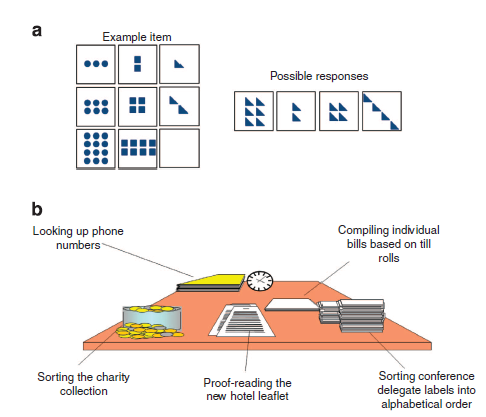
We assess fluid intelligence using the Cattell Culture Fair Test, consisting of pencil-and-paper subtests that yield four summary scores (series completions, odd-one-out, matrices and topology) used in further modelling. […] This consisted of four subtests yielding a sum score each. In contrast to the Cattell test of fluid intelligence, the Hotel test simulates a hotel work environment and measures the ability to distribute performance across multiple tasks, which we will refer to from here on as multitasking.
This is their illustration of the behavioral tasks:
 Again, quoting from Kievit et al. (2014):
Ageing is characterized by declines on a variety of cognitive measures. These declines are often attributed to a general, unitary underlying cause, such as a reduction in executive function owing to atrophy of the prefrontal cortex. However, age-related changes are likely multifactorial, and the relationship between neural changes and cognitive measures is not well-understood. Here we address this in a large (N=567), population-based sample drawn from the Cambridge Centre for Ageing and Neuroscience (Cam-CAN) data. We relate fluid intelligence and multitasking to multiple brain measures, including grey matter in various prefrontal regions and white matter integrity connecting those regions.
Our final goal is to reproduce their final SEM to explain individual differences in the two cognitive facets using the four brain measures of interest:
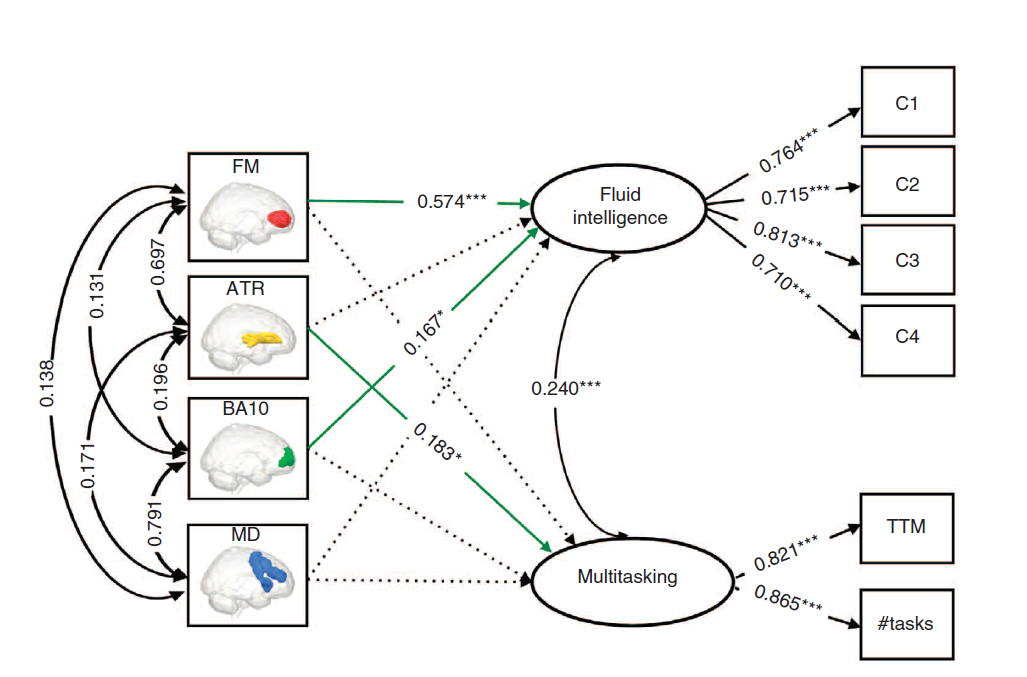 From their path diagram, we can see that they decided to model the six behavioral variables using two latent variables “Fluid Intelligence” and “Multitasking”. The did not model any latent brain factors and used the observed brain scores (GM and WM) as predictors of the latent behavioral variables.
15 Exercise
- Load the dataset “ncomms.dat”, which contains the variances and covariances as reported by Kievit et al. (2014).
- Create a measurement model for cognition using only the behavioral variables. What model fits better? A model with a single performance factor across all six tests? Or two correlated latent factors, one fluid intelligence factor for the Cattell items and one multitasking factor for the Hotel test items? Inspect model fit measures and check whether solutions are admissible (e.g., no negative variances)
- Create a measurement model for the brain. Does a single factor across gray matter volume and white matter volume represent the observed data well? If not, is it possible to represent the data using two correlated factors? A gray matter volume factor with two indicators and a white matter factor with two indicators? If not, what else can we do?
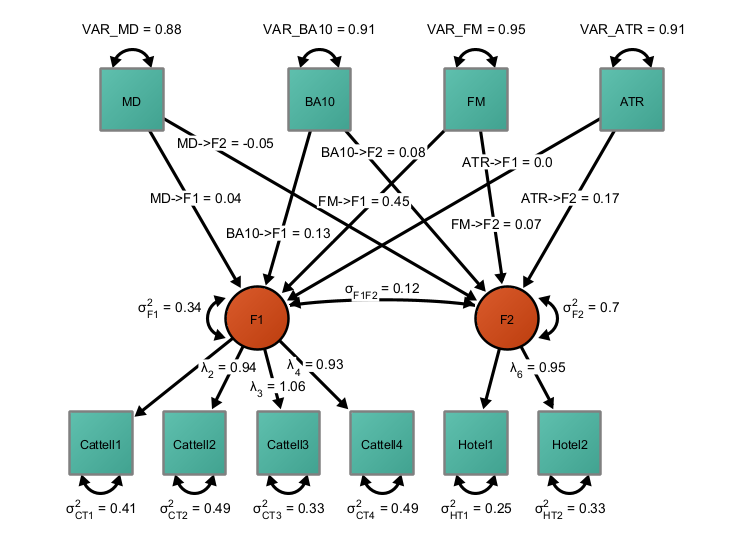
- Fuse both models in one model and use whatever items or factors you chose in your measurement models, such that the brain variables predict behavior. Freely estimate those parameters. What can we learn?
- Discuss the results (e.g., directionality and size of the effects)
- Test whether the effect of FM->MT and ATR->MT is different.
15.1 Solution
Here are some alternative models for the brain variables. First, we model a single factor:
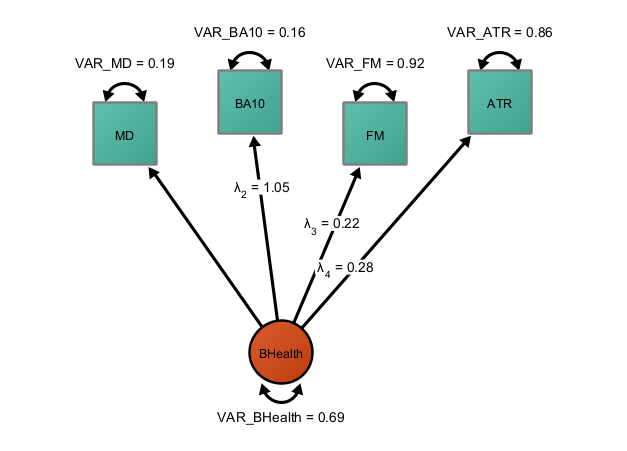
However, model fit and explained variances are not satisfying. Let us try a factor model per modality:
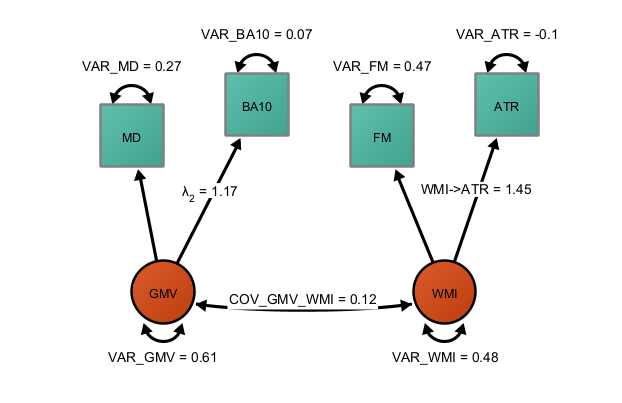
Anegative variance is an indicator for an unsatisfying solution. So, we will not estimate any latent factors and instead keep the observed variables.
Here is a measurement model for the behavioral variables (how does this compare to a single-factor model?):
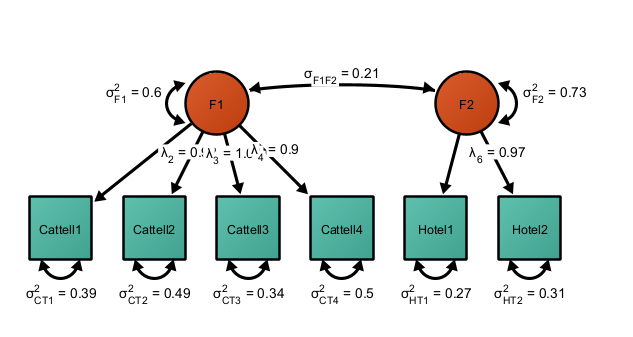
Here is the final model relating the brain scores to the behavioral latent variables: